


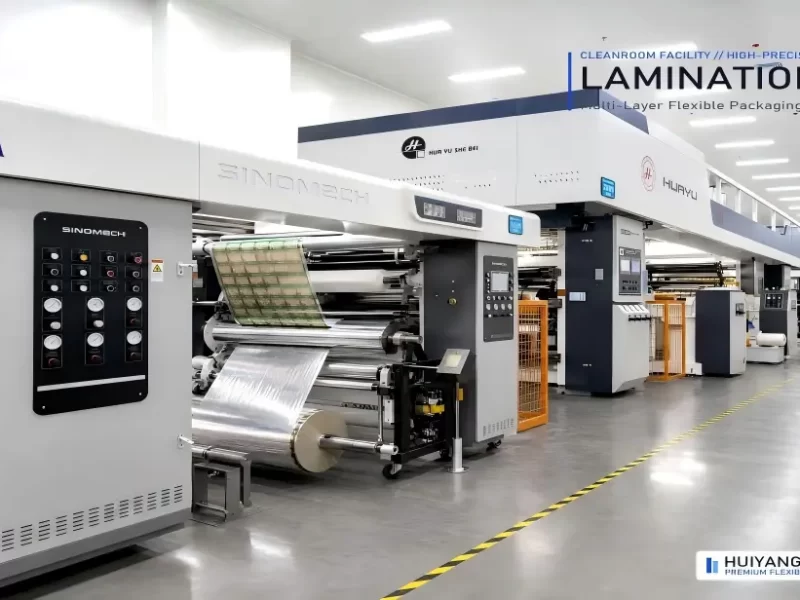
Effective flexible packaging manufacturing depends on precise lamination and curing controls to ensure strong interlayer bonding, packaging durability, and consistent product quality. Manufacturers must monitor adhesive mixing ratios, coating weight, temperature, roller pressure, film tension, and curing conditions throughout production.
As an experienced flexible packaging manufacturer, Huiyang Packaging provides customized laminated pouches and roll films supported by controlled production processes, material selection, and quality management for global B2B buyers.
This article explains how to control lamination and curing processes in flexible packaging manufacturing, identifies common production problems, and outlines the quality management practices buyers should expect from a reliable packaging supplier.
Dry Lamination vs. Solvent-Free Lamination
Dry lamination and solvent-free lamination are two commonly used methods for bonding multilayer flexible packaging materials. Both processes combine different film substrates using adhesives, but their application methods and production requirements differ.
1. Dry Lamination
Dry lamination typically uses solvent-based adhesives.
The adhesive is first applied to one film substrate. The coated film then passes through a drying oven, where solvents evaporate under controlled conditions. After drying, the film is combined with another substrate through heated laminating rollers.
The laminated material is subsequently transferred to a curing area, allowing the adhesive to develop its required bonding properties.
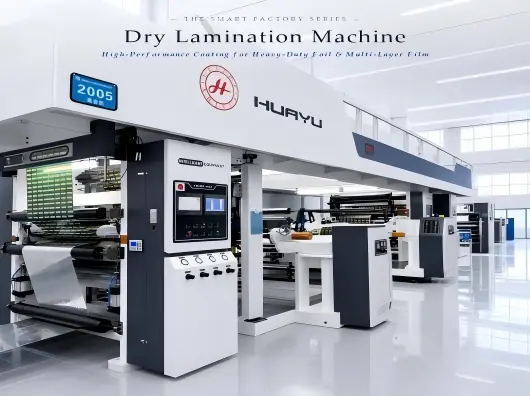
Main production stages:
- Adhesive preparation and mixing: Prepare adhesive components according to the manufacturer’s specified ratio.
- Adhesive coating: Apply a uniform adhesive layer to the film substrate.
- Solvent evaporation: Pass the coated film through a drying oven under controlled temperature and airflow.
- Film bonding: Combine the substrates through laminating rollers.
- Winding and curing: Wind the laminated material and transfer it to the designated curing area.
Dry lamination is widely used for structures involving PET, BOPP, NY, PE, aluminum foil, and metallized films.
Its main process control priorities include adhesive mixing ratios, coating weight, drying temperature, airflow, residual solvent, roller pressure, and film tension.
Insufficient solvent evaporation can leave residual solvents in the laminated structure, potentially affecting packaging quality and suitability for the intended application.
2. Solvent-Free Lamination
Solvent-free lamination uses adhesives that do not require organic solvents as carriers.
Unlike dry lamination, this process does not require a drying oven for adhesive solvent evaporation. Instead, adhesive components are mixed according to the specified ratio, adjusted to the required application temperature, and applied directly to the film surface.
The substrates are then combined through laminating rollers and transferred for curing.
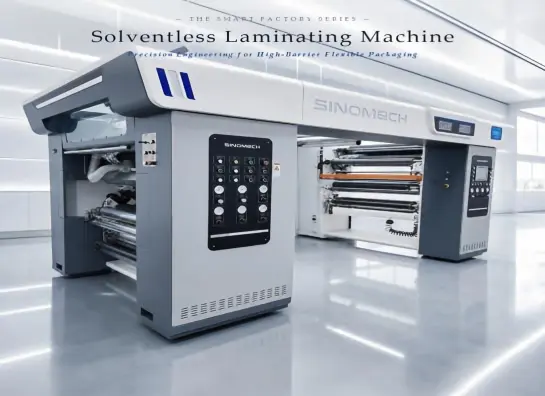
Main production stages:
- Adhesive preparation: Prepare and proportion adhesive components accurately.
- Temperature and viscosity adjustment: Maintain the adhesive within the specified application conditions.
- Adhesive application: Apply the adhesive evenly to the substrate.
- Film bonding: Combine the substrates through laminating rollers.
- Winding and curing: Wind the laminated material and complete the required curing process.
Solvent-free lamination requires precise control of adhesive mixing ratios, temperature, viscosity, coating weight, and application stability.
Its suitability depends on the material structure, adhesive system, packaging application, and production requirements. Not every laminated structure is suitable for the same lamination method.
3. Key Differences Between Dry and Solvent-Free Lamination
| Comparison Factor | Dry Lamination | Solvent-Free Lamination |
|---|---|---|
| Adhesive system | Commonly solvent-based adhesives | Solvent-free adhesives |
| Drying oven | Required | Not required for solvent evaporation |
| Solvent management | Requires controlled solvent removal | No adhesive carrier solvent to remove |
| Main control priorities | Drying, coating, airflow, solvent removal | Mixing ratio, temperature, viscosity, coating |
| Curing | Depends on adhesive chemistry | Depends on adhesive chemistry |
| Material compatibility | Depends on the adhesive and substrate combination | Depends on the adhesive and substrate combination |
The best process is not determined simply by which method is more advanced. Manufacturers should select the appropriate process according to the complete material structure, adhesive specifications, and final packaging application.
For professional flexible packaging manufacturing, process selection must consider bonding requirements, barrier performance, production efficiency, and finished-product quality.
Critical Parameters for Lamination Quality
Regardless of the lamination method, several production parameters directly influence bonding consistency. Controlling these variables is essential for maintaining stable quality across different production batches.
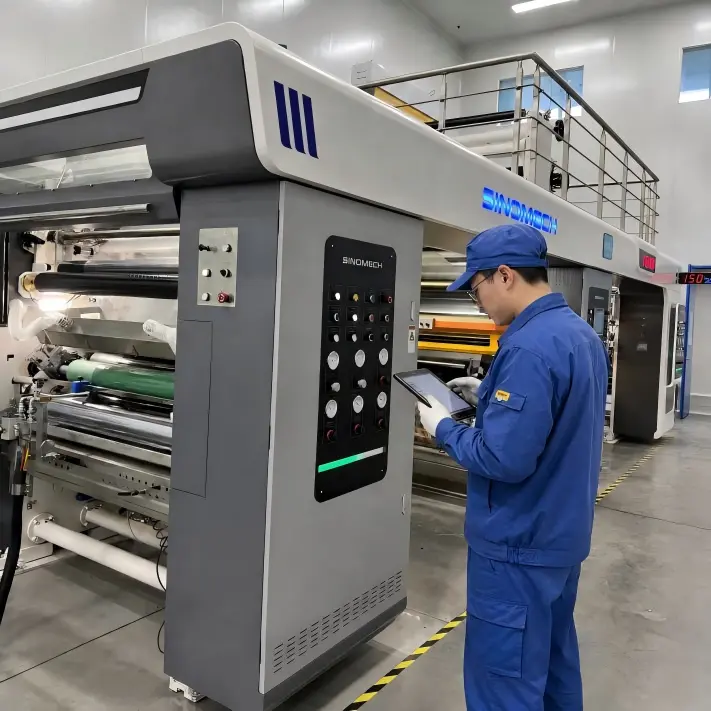
1. Adhesive Mixing Ratio and Viscosity
For two-component adhesive systems, the mixing ratio between the main adhesive component and curing agent must follow the adhesive manufacturer’s technical specifications.
An incorrect ratio can affect the chemical reaction and prevent the adhesive from developing its intended bonding properties.
Excessive curing agent does not necessarily improve bonding and may introduce additional quality problems.
Viscosity is another important consideration because it affects adhesive flow, transfer, and coating uniformity.
Manufacturers should establish procedures to:
- Verify adhesive mixing ratios before production.
- Measure adhesive components accurately.
- Monitor viscosity under controlled conditions.
- Record mixing time and adhesive batch information.
- Observe the specified working time or pot life.
Adhesive should not continue to be used beyond its recommended working time without technical approval.
2. Adhesive Coating Weight
Adhesive coating weight refers to the amount of adhesive applied per unit area of film.
Insufficient coating may result in incomplete adhesive coverage and weak bonding. Excessive coating increases material consumption without necessarily improving bonding performance.
The appropriate coating weight depends on:
- Film material and surface characteristics.
- Adhesive type and viscosity.
- Lamination method.
- Material structure.
- Final packaging application.
Regular coating weight monitoring helps maintain uniform adhesive distribution and consistent bonding across production batches.
In flexible packaging manufacturing, coating weight should be established according to adhesive specifications and validated production requirements rather than applying one fixed value to every material combination.
3. Temperature and Roller Pressure
Temperature influences adhesive viscosity, coating behavior, and bonding conditions.
For dry lamination, drying oven temperatures and airflow must support effective solvent evaporation. For solvent-free lamination, adhesive temperature is particularly important because it affects viscosity and application stability.
Laminating roller temperature and pressure also influence contact between the two substrates.
Insufficient or uneven pressure may affect bonding contact, while excessive pressure can create unwanted processing effects depending on the material structure.
Temperature and pressure should therefore be adjusted according to adhesive specifications, film characteristics, and equipment requirements.
4. Film Tension and Machine Speed
Unstable film tension may cause wrinkles, uneven web alignment, and other processing defects.
Machine speed also affects process stability.
In dry lamination, excessive speed may reduce the available drying time, resulting in insufficient solvent evaporation.
In solvent-free lamination, production speed must remain compatible with adhesive metering, coating stability, and equipment capabilities.
Increasing machine speed without evaluating its effect on process conditions may compromise lamination quality.
Stable tension control and appropriate production speeds are essential for maintaining consistent material alignment and bonding performance.
Why Curing Control Is Essential
Curing is a critical stage in many laminated flexible packaging processes.
After film layers are bonded, certain adhesive systems require additional time under controlled conditions to develop their intended bonding properties.
For reactive polyurethane adhesive systems, curing involves chemical reactions between adhesive components that help form the final adhesive network.
This means that bonding strength immediately after lamination may differ from the strength achieved after the recommended curing period.
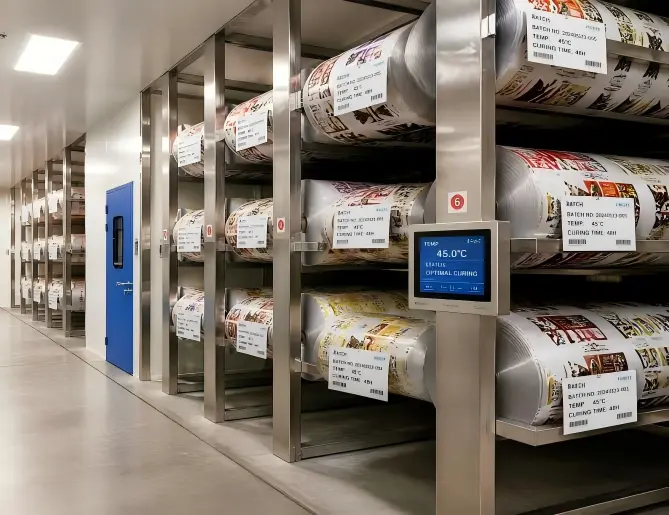
1. How Curing Time and Temperature Affect Bonding
Curing time and temperature influence the development of adhesive properties.
Appropriate curing conditions help improve:
- Interlayer bonding strength.
- Adhesive cohesion.
- Resistance to subsequent pouch converting.
- Performance during storage and use.
The required curing conditions depend on adhesive chemistry, material structure, and production requirements.
Higher temperatures do not automatically produce better bonding. Excessive temperatures may affect the adhesive system or film substrates.
Manufacturers must follow adhesive supplier recommendations rather than applying identical curing conditions to every packaging structure.
2. Risks of Insufficient Curing
If laminated materials enter pouch production before sufficient bonding strength has developed, problems may occur during subsequent processing or storage.
Potential issues include:
| Quality Problem | Possible Consequence |
|---|---|
| Insufficient interlayer bonding | Weak adhesion between film layers |
| Delamination around stress areas | Reduced packaging integrity |
| Bonding instability | Problems during pouch converting |
| Changes in bonding during storage | Reduced long-term packaging reliability |
In some cases, finished packaging may pass initial inspection but develop delamination after an extended storage period.
This is why curing must be treated as an essential production control stage rather than simply a waiting period after lamination.
3. Establishing a Curing Management System
A reliable curing management system should include the following steps:
- Follow adhesive specifications: Confirm the recommended curing time and temperature for the selected adhesive system.
- Record lamination time: Identify when each production batch enters the curing stage.
- Monitor temperature: Check and record actual curing room conditions.
- Track curing duration: Ensure each batch completes the required curing period.
- Control batch identification: Prevent materials from entering subsequent production prematurely.
- Verify bonding performance: Conduct appropriate inspections before releasing materials for further processing.
There is no universal curing time suitable for every laminated flexible packaging structure. Actual requirements must be determined according to adhesive manufacturer specifications and validated production conditions.
For flexible packaging manufacturing, batch-level curing records are essential for traceability, process consistency, and quality investigations.
Common Lamination and Curing Problems
Understanding common production problems helps manufacturers identify potential quality risks and investigate their causes.
The following table summarizes frequent defects, their possible causes, and recommended controls.
| Production Problem | Possible Causes | Recommended Control |
|---|---|---|
| Uneven bonding | Inconsistent coating or roller conditions | Monitor coating uniformity and roller settings |
| Low bonding strength | Incorrect adhesive ratio or incompatible materials | Verify adhesive preparation and material compatibility |
| Residual solvent | Insufficient drying or excessive machine speed | Review drying temperature, airflow, and production speed |
| Wrinkles | Unstable film tension or web alignment | Adjust tension and alignment |
| Delamination after storage | Insufficient curing or unsuitable process conditions | Review curing records and bonding performance |
| Inconsistent batch quality | Variations in materials or process parameters | Strengthen process monitoring and traceability |
It is important to recognize that similar defects may have different underlying causes.
For example, low bonding strength does not automatically mean curing time is insufficient. The problem may also involve adhesive compatibility, film surface conditions, coating weight, or other production factors.
A systematic investigation should consider the complete lamination process rather than changing individual parameters without identifying the actual cause.
Quality Control Throughout Flexible Packaging Manufacturing
For large-volume packaging orders, consistent quality across production batches is essential.
A reliable flexible packaging manufacturing quality management system should cover the entire production process, from incoming materials to finished-product inspection.
1. Incoming Material Inspection
Before lamination, film substrates should be checked for:
- Material thickness and specifications.
- Surface appearance and cleanliness.
- Surface treatment conditions, where applicable.
- Material identification and batch information.
Material compatibility must also be evaluated before production to ensure that the selected substrates and adhesive system meet the intended application requirements.
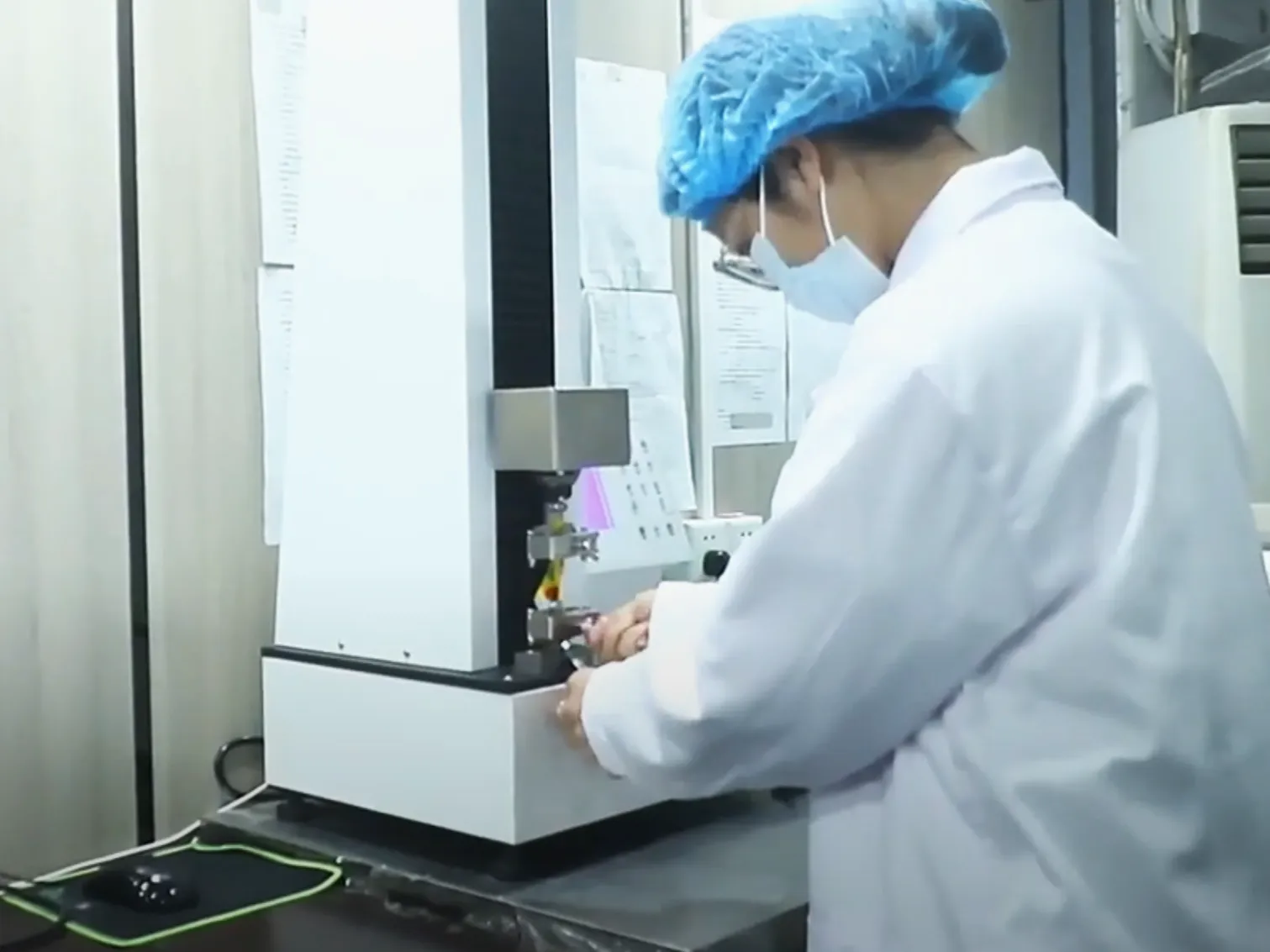
2. In-Process Lamination Monitoring
Production personnel should monitor critical process parameters throughout lamination, including:
- Adhesive mixing ratios and viscosity.
- Adhesive coating weight.
- Drying conditions, where applicable.
- Roller temperature and pressure.
- Film tension and machine speed.
Documented monitoring helps identify process deviations before they affect a complete production batch.
3. Curing Management and Traceability
Each laminated roll should have clear batch identification and records covering:
- Lamination time.
- Adhesive information and batch number.
- Curing start and completion times.
- Actual curing temperature.
- Production batch identification.
These records help prevent premature processing and allow manufacturers to investigate quality issues more efficiently.
4. Finished-Product Inspection
After pouch converting, packaging should be evaluated according to project specifications.
Relevant inspection items may include:
| Inspection Item | Quality Objective |
|---|---|
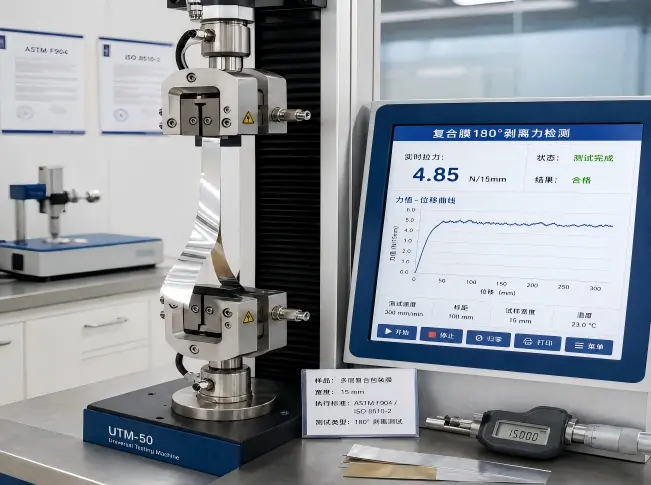
| Interlayer peel strength | Evaluate bonding between laminated substrates |
| Lamination appearance | Identify bubbles, wrinkles, and visible defects |
| Heat-sealing performance | Verify seal integrity under specified conditions |
| Pouch dimensions | Confirm dimensional accuracy |
| Structural integrity | Evaluate the finished pouch structure |
| Residual solvent | Assess compliance with applicable project requirements |
| Application performance | Verify suitability for the intended product and conditions |
For special applications, additional validation may be necessary.
For example, retort packaging requires testing under specified sterilization conditions, while high-barrier packaging may require oxygen and water vapor transmission testing.
Testing methods, acceptance criteria, and sampling frequency should be established according to the packaging specification and applicable standards.
What Should Packaging Buyers Ask Their Suppliers?
When evaluating flexible packaging suppliers, buyers should look beyond production capacity and equipment lists.
A supplier’s ability to manage lamination and curing processes is equally important, particularly for multilayer structures, high-barrier packaging, and products requiring long storage periods.
Before placing a bulk order, buyers should ask the following questions:
1. Which lamination process do you use?
Can the supplier select a suitable process for the required material structure and application?
2. How do you evaluate adhesive compatibility?
Are adhesives selected according to the complete material combination and final packaging application?
3. How are adhesive preparation and coating controlled?
Are mixing ratios, viscosity, and coating weight monitored during production?
4. Do you have a documented curing management procedure?
Are curing time, temperature, and batch information recorded?
5. How do you verify finished packaging quality?
Are peel strength, heat-sealing performance, and other relevant indicators inspected according to project requirements?
6. Can you support customized packaging structures?
Can the supplier recommend suitable material combinations, pouch formats, and production specifications according to product protection and market requirements?
These questions help importers, wholesalers, distributors, and brand owners assess whether a supplier has the manufacturing and quality management capabilities required for long-term cooperation.
A qualified manufacturing partner should be able to explain its production controls, material selection process, inspection procedures, and batch traceability requirements.
Frequently Asked Questions
Q1. What is lamination in flexible packaging manufacturing?
Lamination is the process of bonding two or more flexible packaging substrates using adhesives to create a multilayer structure. It combines the properties of different materials to achieve the required mechanical strength, barrier protection, print quality, and sealing performance.
Q2. What is the difference between dry lamination and solvent-free lamination?
Dry lamination typically uses solvent-based adhesives and requires a drying oven to evaporate solvents before bonding. Solvent-free lamination uses adhesives without organic carrier solvents and does not require solvent evaporation. Both processes require controlled adhesive application, bonding, and curing.
Q3. Why is curing important in laminated flexible packaging?
Curing allows certain adhesive systems to develop their intended bonding properties after lamination. Insufficient curing can result in weak interlayer adhesion, delamination during pouch converting, and reduced packaging reliability during storage.
Q4. What causes delamination in flexible packaging?
Delamination can result from incorrect adhesive mixing ratios, unsuitable adhesive and substrate combinations, insufficient coating weight, poor film surface conditions, improper lamination parameters, or inadequate curing. Identifying the actual cause requires evaluating the complete production process.
Q5. How can manufacturers improve lamination bonding strength?
Manufacturers can improve bonding consistency by selecting compatible materials and adhesives, controlling adhesive mixing ratios and viscosity, maintaining uniform coating weight, adjusting temperature and roller pressure, stabilizing film tension, and following validated curing conditions.
Q6. How long does laminated flexible packaging need to cure?
There is no universal curing period for all laminated packaging materials. The required duration depends on adhesive chemistry, film structure, curing temperature, and application requirements. Manufacturers should follow adhesive supplier specifications and verify bonding performance before further processing.
Q7. What quality tests are important for laminated flexible packaging?
Important tests include interlayer peel strength, lamination appearance, heat-sealing performance, dimensional inspection, and residual solvent testing where applicable. Specialized applications may also require retort validation, oxygen transmission rate (OTR), and water vapor transmission rate (WVTR) testing.
Q8. How can buyers evaluate a flexible packaging manufacturer?
Buyers should evaluate material selection capabilities, lamination processes, adhesive management, curing procedures, batch traceability, finished-product inspection, customization capabilities, and relevant quality certifications. These factors help determine whether a supplier can maintain consistent quality for long-term bulk orders.
Conclusion: Choose a Reliable Partner for Consistent Flexible Packaging Quality
Consistent lamination quality depends on coordinated control of material compatibility, adhesive preparation, coating conditions, machine parameters, and subsequent curing management.
Dry lamination and solvent-free lamination have different process requirements, but both demand accurate production control to achieve reliable bonding performance.
For manufacturers, controlling adhesive ratios, coating weight, temperature, pressure, film tension, and curing conditions helps reduce production variations, prevent delamination, and improve batch consistency.
Choosing an experienced partner for flexible packaging manufacturing is equally important. Buyers need a supplier that understands material structures, production requirements, and quality control throughout the manufacturing process.
Huiyang Packaging is a flexible packaging manufacturer with more than 25 years of industry experience, specializing in customized OEM/ODM flexible packaging solutions. We provide a range of packaging products, including stand-up pouches, spout pouches, vacuum bags, pillow bags, flat-bottom bags, cold-seal films, and rollstock films for food, daily chemical, pharmaceutical, and cosmetic applications.
Supported by integrated capabilities in material development, design assistance, high-speed printing, lamination, and bag making, we provide customized packaging solutions for global importers, wholesalers, distributors, and brand owners. Our quality management system is supported by ISO 9001, SGS, and FDA-related standards and requirements.
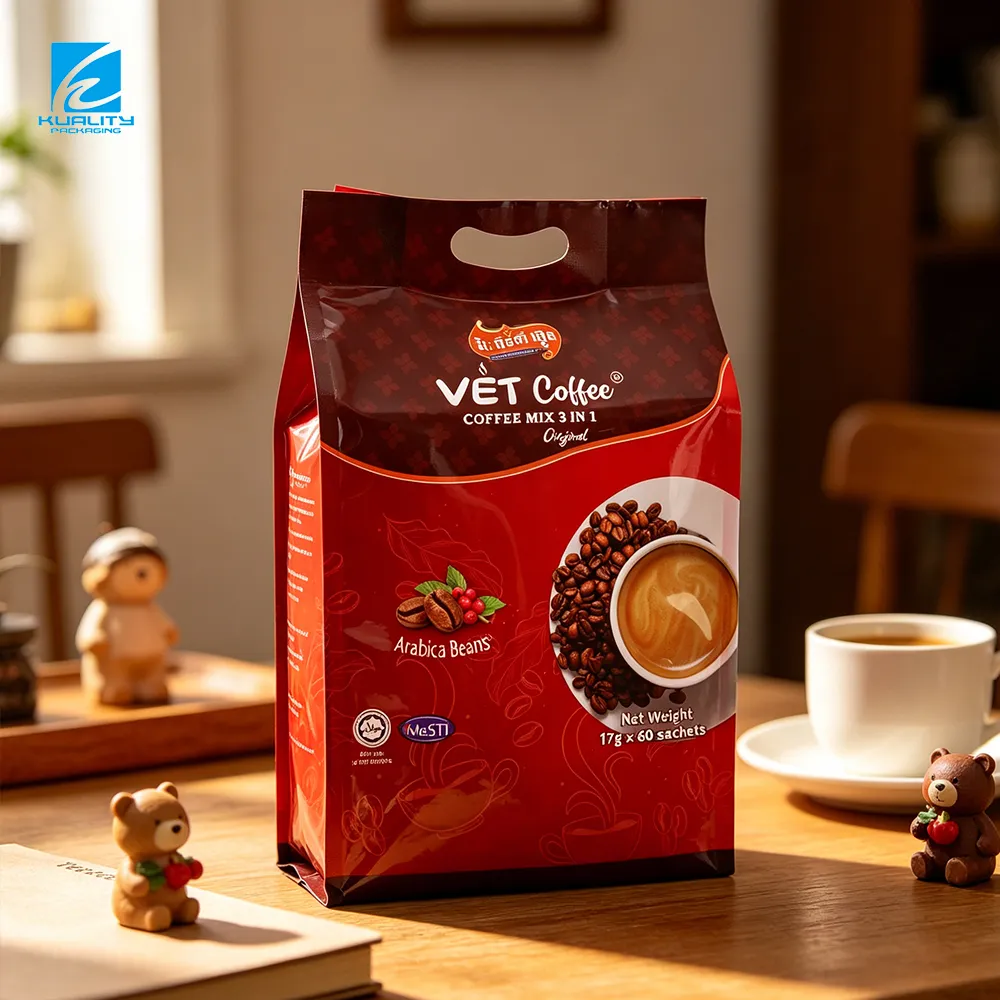
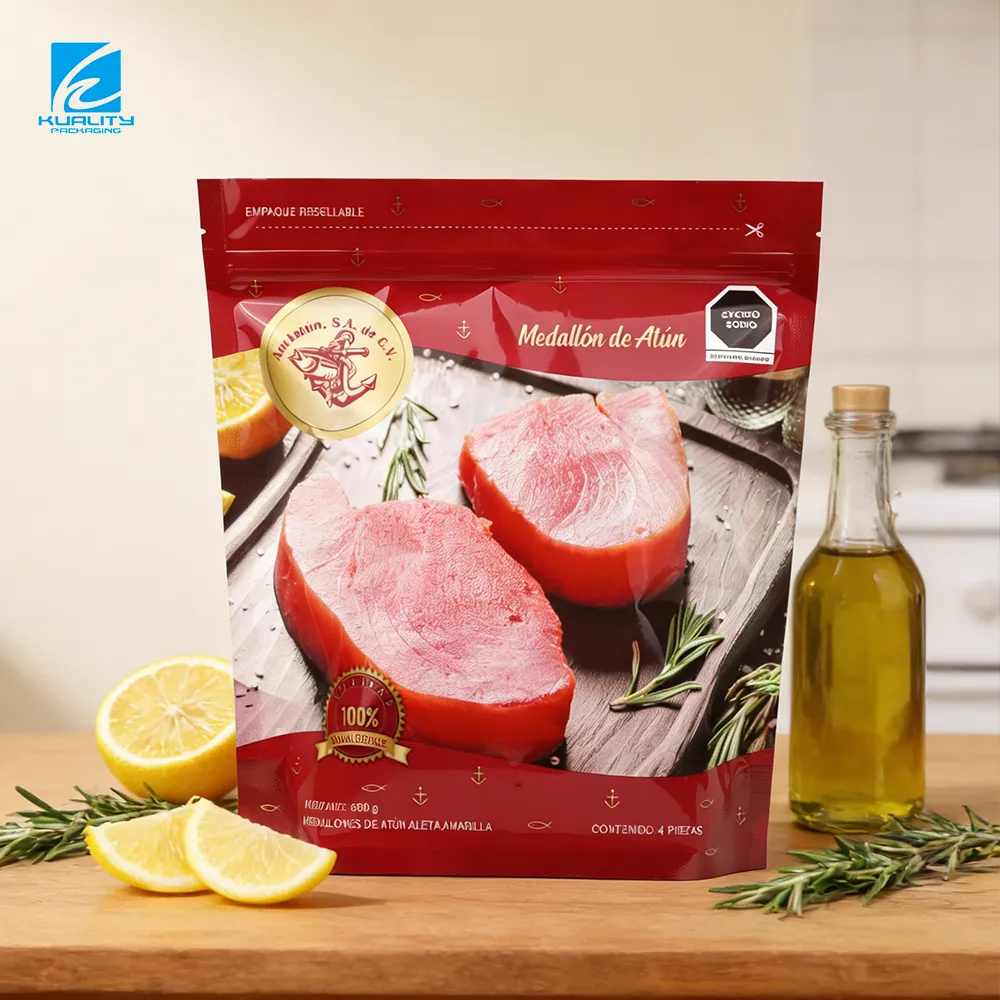
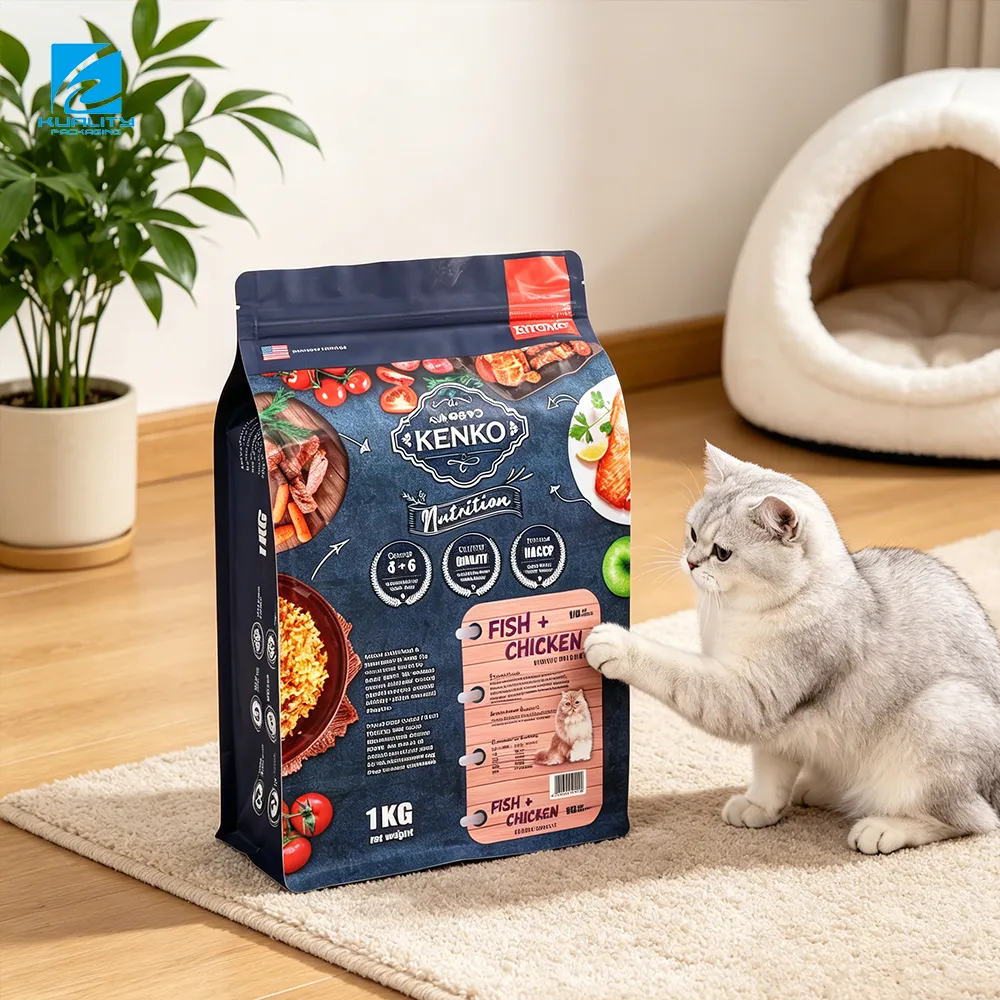
Whether you are developing coffee packaging, food pouches, pet food packaging, or other customized flexible packaging projects, our team can discuss suitable material structures and manufacturing requirements based on your product application.
Contact Huiyang Packaging today to discuss your project, request a customized packaging solution, and build a reliable long-term manufacturing partnership.