


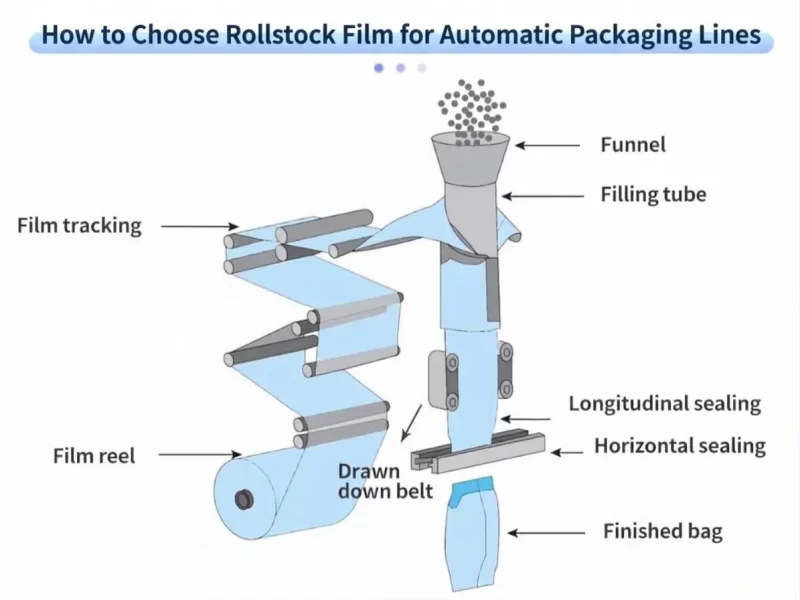
Choosing the right rollstock film for an automatic packaging line requires matching the film structure, sealing performance, thickness, barrier properties, and roll dimensions to both the product and the packaging machine. The right specification improves production stability, protects product quality, and controls material costs.
Huiyang Packaging is an experienced flexible packaging manufacturer offering custom OEM/ODM rollstock film solutions, from material selection and printing to finished packaging production.
This guide explains how to evaluate each factor and prepare the right specifications before requesting a quotation from a roll film manufacturer.
1. Start With Your Automatic Packaging Machine
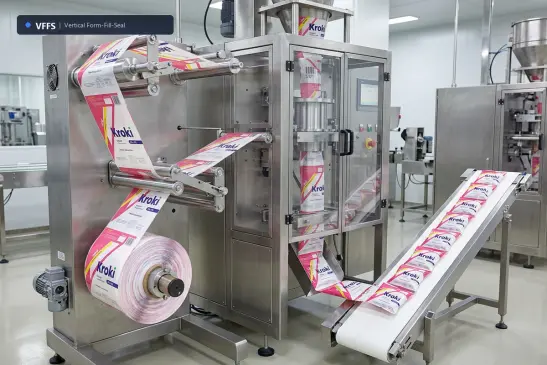
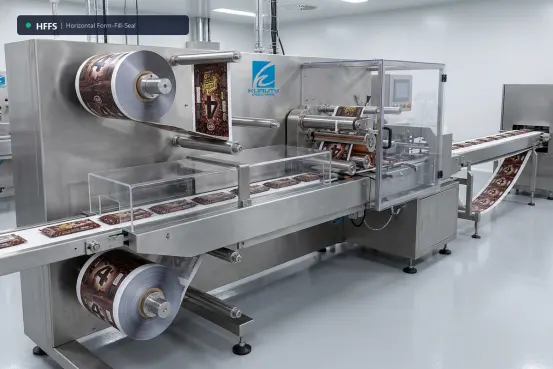
Before selecting a film structure, identify the type of automatic packaging machine used in production. The two common systems are Vertical Form Fill Seal (VFFS) and Horizontal Form Fill Seal (HFFS).
| Machine Type | Working Process | Common Applications |
|---|---|---|
| VFFS | Film moves vertically, forms a bag, receives the product, and is sealed. | Snacks, nuts, grains, powders, pet food |
| HFFS | Film moves horizontally through forming, filling, and sealing operations. | Biscuits, confectionery, and selected food products |
The machine determines important film requirements, including width, forming characteristics, sealing conditions, and roll dimensions.
When contacting a supplier, prepare:
- Machine type and model
- Required film width and finished bag size
- Packaging speed
- Sealing method
- Core diameter
- Maximum roll diameter
- Existing film specifications or physical samples
These details help the manufacturer evaluate machine compatibility before recommending a material structure.
2. Select the Film Structure According to Your Product
There is no universal material structure for flexible packaging. The correct combination depends on product sensitivity, shelf-life requirements, transportation conditions, and packaging performance.
Common laminated rollstock film structures include:
| Material Structure | Main Characteristics | Typical Applications |
|---|---|---|
| BOPP/PE | Printability and heat-sealing performance | Dry food, snacks |
| BOPP/MCPP | Moisture protection and heat resistance | Snack packaging |
| PET/PE | Mechanical strength and sealing performance | General food packaging |
| PET/CPP | Heat resistance and mechanical stability | Selected food applications |
| PET/MPET/PE | Light and moisture barrier | Dry products |
| PET/VMPET/PE | Improved light and oxygen barrier | Snacks, coffee, powders |
| PET/NY/PE | Puncture resistance and flexibility | Products requiring stronger protection |
| PET/AL/PE | High barrier against light, oxygen, and moisture | Sensitive food products |
| PE/PE | Polyethylene-based structure with potential for mono-material design | Selected flexible packaging applications |
These structures are starting points, not universal specifications. Actual performance depends on material grades, layer thicknesses, lamination quality, and sealing requirements.
Consider these product-specific priorities:
- Coffee: Oxygen and moisture protection, aroma retention, and light protection.
- Snacks: Moisture resistance to preserve crispness and reliable heat sealing.
- Powders: Moisture protection, seal integrity, and resistance to leakage.
- Pet food: Barrier performance, puncture resistance, and mechanical strength.
Select the structure according to the product’s actual protection requirements rather than copying a commonly used specification.


3. Evaluate the Heat-Sealing Layer
Heat-sealing performance directly affects automatic packaging efficiency. The inner sealant layer must match the machine’s temperature, pressure, dwell time, and operating speed.
An unsuitable sealing layer can cause:
- Weak or incomplete seals
- Product leakage
- Wrinkled or contaminated sealing areas
- Unstable sealing during continuous production
When evaluating rollstock film, consider the complete laminated structure and its sealing window rather than examining the sealant layer alone.
For technical quality control, ASTM F88/F88M-23 provides a recognized method for measuring flexible barrier material seal strength. The test measures the force required to separate a sealed specimen and identifies its failure mode. Buyers can use this method as a reference when establishing seal-strength requirements with suppliers.
4. Choose the Appropriate Film Thickness
Thicker film does not automatically mean better packaging. The required thickness depends on product weight, bag dimensions, material structure, transportation conditions, and mechanical requirements.
A suitable specification should balance:
- Mechanical strength and puncture resistance.
- Flexibility and machine-forming performance.
- Barrier protection and sealing reliability.
- Material consumption and overall packaging cost.
For automatic production, the film must also feed and form consistently. A film with sufficient tensile strength can still perform poorly if its stiffness, structure, or forming characteristics do not match the machine.
Ask the manufacturer to evaluate thickness together with the complete material structure and production conditions.
5. Confirm All Roll Specifications
Even when the material structure is correct, incorrect roll dimensions can cause feeding, forming, or printing-registration problems.
Confirm the following specifications before mass production:
| Specification | What Buyers Need to Confirm |
|---|---|
| Film width | Compatibility with machine requirements |
| Film thickness | Total thickness and agreed tolerance |
| Roll length or weight | Production requirements and roll replacement frequency |
| Core diameter | Compatibility with the machine shaft |
| Maximum roll diameter | Machine loading capacity |
| Winding direction | Correct installation and film feeding |
| Printing repeat | Match with finished bag dimensions |
| Splicing requirements | Joint quantity and identification, if applicable |
For high-speed packaging lines, accurate roll specifications help reduce downtime and unnecessary material waste.
6. Prepare Printing Artwork for Automatic Packaging
Custom printed rollstock film must be designed around the final bag format, not just the flat artwork.
The printing repeat, film width, forming direction, and sealing areas must work together. Before printing, confirm:
- Finished bag dimensions
- Printing repeat and direction
- Artwork position and color requirements
- Registration requirements
- Areas reserved for sealing and forming
A design that looks correct on screen may require adjustments before production. Requesting a print layout or production drawing before approval helps prevent artwork positioning problems.
7. Match Barrier Performance to Product Requirements
Different products require different levels of protection. The main factors include oxygen transmission, moisture transmission, light exposure, aroma retention, and mechanical strength.
| Product | Primary Protection Requirements |
|---|---|
| Coffee | Oxygen, moisture, aroma, and light |
| Snacks | Moisture and oxidation protection |
| Powder products | Moisture protection and seal integrity |
| Light-sensitive products | Light-blocking performance |
| Heavy products | Mechanical strength and puncture resistance |
Higher-barrier structures increase material complexity and cost. However, insufficient protection can shorten product shelf life and affect product quality.
The objective is to specify the barrier performance required for the intended shelf life and distribution environment, rather than automatically choosing the highest-barrier material.
Real Cases: Selecting Film for a Snack Packaging Line
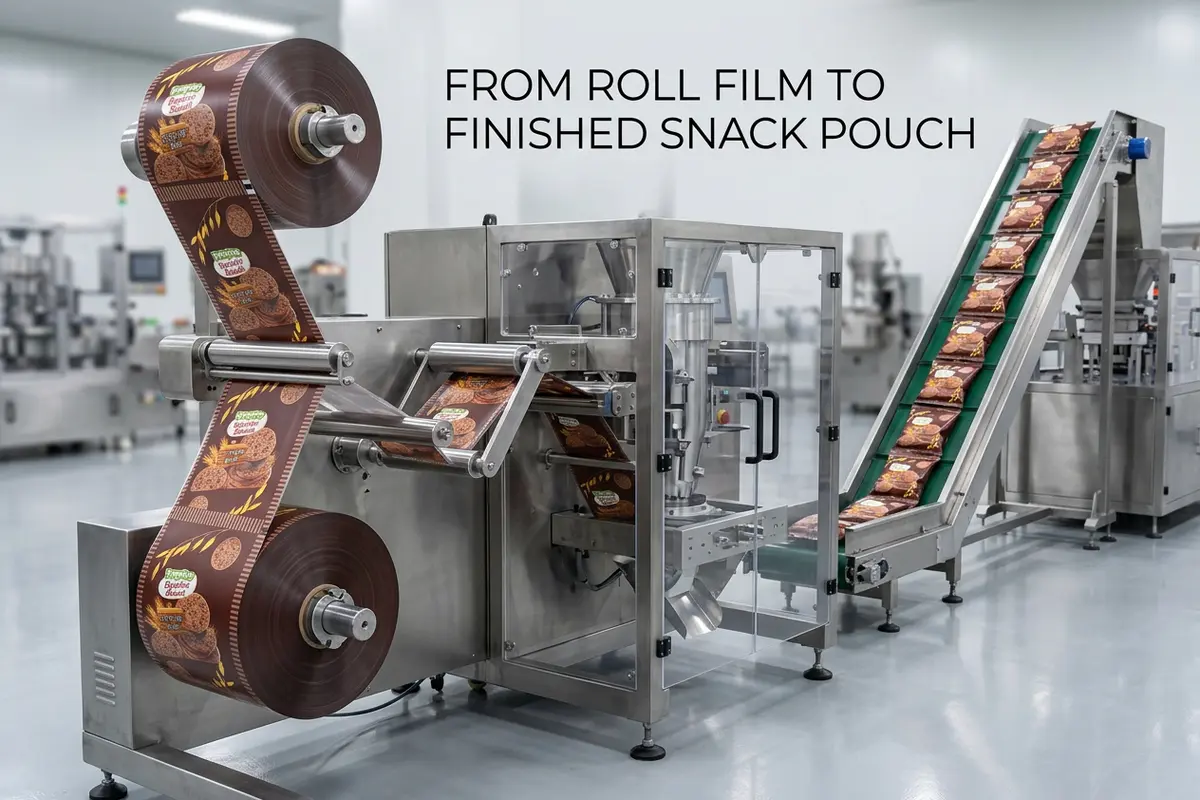
In a previous project, a factory customer approached Huiyang Packaging for roll film used on an automatic snack packaging line.
Initially, the customer provided the finished bag dimensions, packaging artwork, and preferred film thickness. However, these details alone were insufficient to determine the best specification.
After reviewing the project, we also considered the machine type, product weight, packaging speed, sealing requirements, and required moisture protection.
This changed the material selection process. Instead of choosing the film based on thickness alone, we evaluated the complete structure, sealant layer, and machine compatibility together.
This demonstrates an important purchasing principle: packaging film must perform as part of the entire production system.
What Information Should You Send to a Roll Film Supplier?
A complete inquiry helps a manufacturer evaluate the project and provide a more accurate quotation.
Prepare the following information whenever available:
- Product type and application.
- Product weight or filling volume.
- Finished bag dimensions.
- Packaging machine type and model.
- Required film width.
- Preferred film thickness.
- Existing material structure, if available.
- Barrier and shelf-life requirements.
- Printing artwork or design files.
- Estimated order quantity.
You do not need to finalize every specification before contacting a supplier. An experienced manufacturer can review your product and equipment requirements and recommend suitable options.
Rollstock Film vs. Pre-Made Pouches: Which Is Better?
The main difference is when the bag is formed during the packaging process.
| Comparison | Rollstock Film | Pre-Made Pouches |
|---|---|---|
| Bag production | Formed directly on the packaging machine | Manufactured before filling |
| Equipment | Requires compatible form-fill-seal equipment | Uses suitable pouch-filling equipment |
| Production process | Forming, filling, and sealing in one continuous operation | Feeding, filling, and sealing prepared bags |
| Best suited for | Automated continuous production | Products and lines designed for ready-made bags |
For manufacturers operating compatible form-fill-seal equipment, roll film provides an integrated packaging process. Pre-made pouches are suitable when the production line is designed around ready-made bags.
The right choice depends on equipment, production volume, package format, and overall operating costs.
Frequently Asked Questions
1. Can the same rollstock film work on different packaging machines?
Not always. Different machines have different requirements for film width, roll dimensions, forming methods, and sealing conditions. Confirm compatibility before changing suppliers or film specifications.
2. Do I need to know the exact material structure before requesting a quotation?
No. Product type, finished bag dimensions, machine model, and required barrier performance provide a starting point. A manufacturer can recommend suitable structures based on these details.
3. Can a manufacturer reproduce my existing roll film?
Yes. An existing material specification, production drawing, or physical sample helps the manufacturer evaluate the original structure and develop a matching or alternative solution.
4. Is custom-printed rollstock film available?
Yes. Manufacturers can customize material structures, film widths, printing colors, repeat lengths, and artwork according to packaging requirements.
5. What is the most important factor when choosing automatic packaging film?
Machine compatibility is essential, but it must be evaluated together with product protection, sealing performance, mechanical strength, and roll specifications. All these factors determine whether the film performs reliably in production.
Conclusion: Get Custom Rollstock Film from Huiyang Packaging
Choosing the right rollstock film for an automatic packaging line requires matching the film structure, sealing performance, thickness, barrier properties, and roll dimensions to both the product and the packaging machine. The right specification improves production stability, protects product quality, and controls material costs.
Huiyang Packaging is a professional flexible packaging manufacturer with more than 25 years of industry experience, specializing in OEM/ODM packaging solutions for global buyers. Our production capabilities cover high-speed printing, lamination, bag making, material development, and packaging design support.
We supply custom rollstock film and flexible packaging products for food, daily chemical, pharmaceutical, and cosmetic applications. Supported by an ISO 9001 quality management system and relevant SGS and FDA standards, we focus on delivering consistent product quality and dependable manufacturing solutions.
Whether you need custom printed film, high-barrier laminated structures, or packaging materials compatible with automatic VFFS and HFFS lines, our team can help evaluate your requirements.
Contact Huiyang Packaging today. Send us your product details, packaging machine specifications, existing film sample, or artwork to discuss a suitable solution and request a factory-direct quotation.


