


When launching a new product or scaling production, one of the first questions many brands ask is: “What is the Minimum Order Quantity for custom packaging?”
For food brands, coffee roasters, pet food companies, frozen food suppliers, and daily chemical brands, packaging is not only a container. It affects product protection, shelf presentation, transportation efficiency, and total purchasing cost. That is why understanding MOQ is important before ordering custom flexible packaging bags.
As a professional flexible packaging manufacturer, Huiyang Packaging frequently receives inquiries about MOQ for custom printed packaging bags, stand-up pouches, flat bottom bags, spout pouches, three-side seal bags, and rollstock films. In this article, we explain what MOQ means, why it exists, what affects MOQ, and how brands can choose the right order quantity for custom flexible packaging bags.
What Is Minimum Order Quantity (MOQ)?
Minimum Order Quantity, usually called MOQ, refers to the smallest quantity a packaging manufacturer is willing to produce in one custom order.
For custom flexible packaging bags, MOQ is not simply a sales requirement. It is closely related to production efficiency, material sourcing, printing preparation, machine setup, and quality control.
In flexible packaging manufacturing, MOQ is mainly affected by:
- Material procurement
- Printing plate or cylinder preparation
- Machine setup and calibration
- Bag-making or film production efficiency
- Lamination structure
- Quality control inspection
- Production scheduling
Without a reasonable MOQ, the unit cost of custom packaging would increase significantly. This is because many production costs remain fixed whether the order is small or large. For example, machine setup, printing cylinder preparation, and quality inspection are still required even if the order quantity is low.
Typical MOQ for Custom Flexible Packaging Bags and Rollstock Films
At Huiyang Packaging, we specialize in custom flexible packaging bags and rollstock films for food, coffee, pet food, frozen food, snack, beverage, and daily chemical applications.
Our typical MOQ guidelines are:
| Packaging Type | Typical MOQ |
| Stand-Up Pouches | ≥50,000 pcs |
| Three-Side Seal Bags | ≥50,000 pcs |
| Flat Bottom Bags | ≥50,000 pcs |
| Spout Pouches | ≥50,000 pcs |
| Rollstock Film | ≥500 kg |
In general, custom bags start from 50,000 pieces per order, depending on bag type, size, material structure, and printing complexity. Rollstock films usually start from 500 kg per order, depending on film width, laminate layers, and material combination.
These MOQ guidelines help ensure stable production quality, better printing consistency, efficient material usage, and more competitive unit pricing.

Why Does MOQ Exist in Custom Flexible Packaging Manufacturing?
MOQ exists because custom flexible packaging bags require several preparation steps before mass production can begin.
Material Procurement
Flexible packaging often uses customized film structures, such as PET/PE, PET/AL/PE, BOPP/VMPET/PE, Kraft Paper/PE, or Kraft Paper/AL/PE. These materials must be purchased, prepared, and matched according to the product’s barrier requirements, sealing performance, and packaging application.
If the order quantity is too low, material waste and procurement cost become much higher per unit.
Printing Preparation
For custom printed packaging bags, artwork preparation and printing setup are essential. If rotogravure printing is used, engraved cylinders are required for each design and color. This creates an upfront cost before printing begins.
Because of this, gravure printing is more suitable for medium to large production runs where the cost can be spread across a higher quantity.
Machine Setup and Calibration
Before producing custom flexible packaging bags, machines must be set according to bag size, film width, sealing requirements, zipper position, spout location, gusset structure, and cutting dimensions.
Every setup takes time and labor. A reasonable MOQ ensures that machine setup costs are balanced by efficient production output.
Quality Control
Custom packaging requires quality checks during and after production. These may include printing color inspection, lamination strength testing, sealing performance checks, size verification, appearance inspection, and packaging confirmation.
MOQ helps manufacturers maintain quality control standards without making the unit cost too high.
Main Factors That Affect MOQ
The MOQ for custom flexible packaging bags is not the same for every project. It can change depending on the bag style, size, material, printing method, and number of SKUs.
Bag Size and Bag Style
Bag dimensions directly affect material consumption. Larger bags use more film, while smaller bags may require more precise machine adjustment.
Bag style also matters. A simple three-side seal bag is usually easier to produce than a flat bottom pouch or spout pouch. Additional features such as zippers, tear notches, hang holes, clear windows, valves, spouts, and gussets may also influence MOQ.
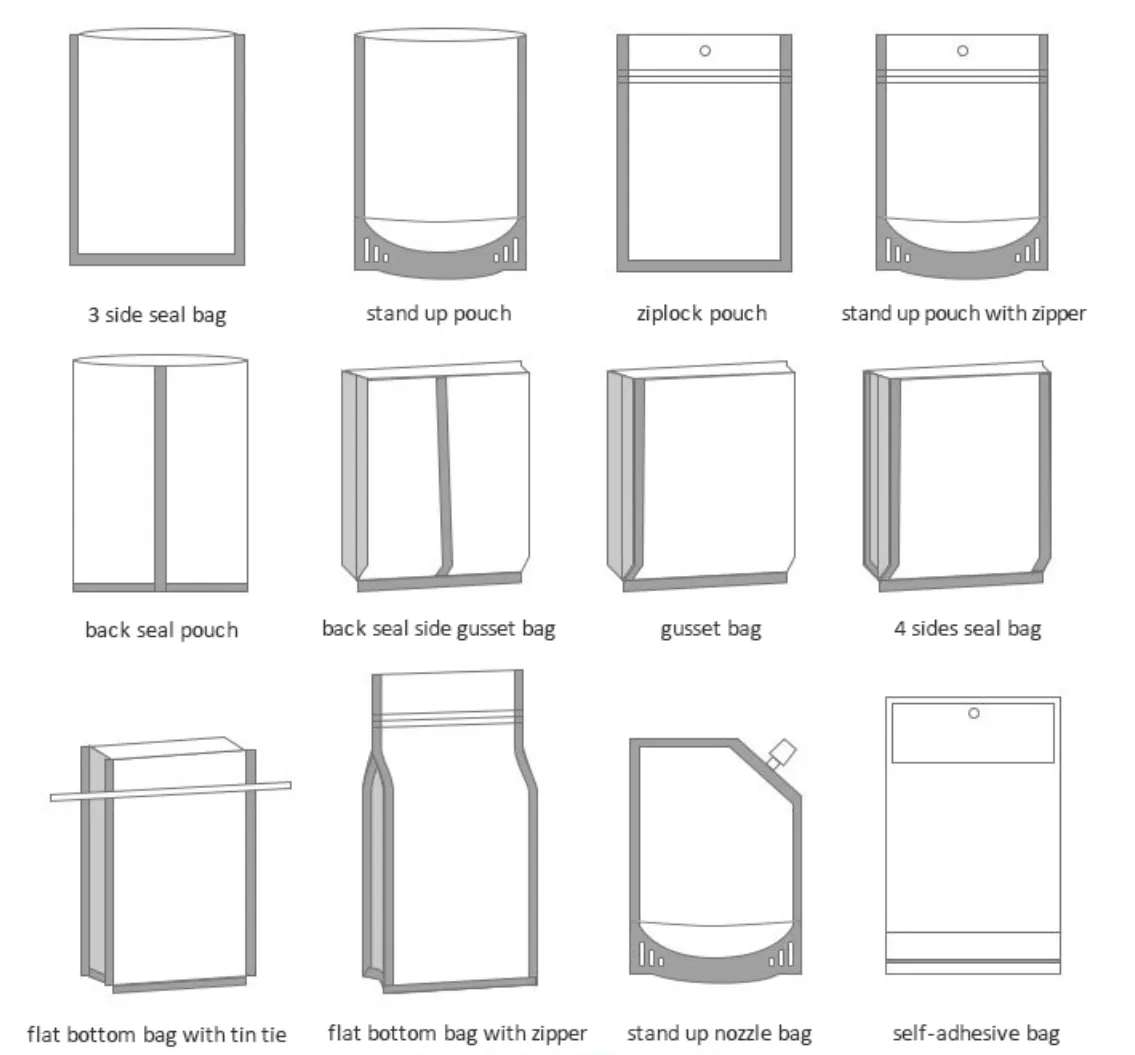
Common custom bag styles include:
- Stand-up pouches
- Flat bottom pouches
- Three-side seal bags
- Side gusset bags
- Spout pouches
- Vacuum bags
- Shaped pouches
- Coffee bags with valves
- Frozen food bags
- Pet food bags
More complex bag structures usually require more setup time and may lead to different MOQ requirements.
Material Structure
Material structure is one of the most important factors affecting MOQ. Custom flexible packaging bags often use multi-layer laminates to achieve different functions, such as moisture resistance, oxygen barrier, aroma protection, puncture resistance, oil resistance, or freezer durability.
Common material structures include:
- PET/PE
- PET/AL/PE
- BOPP/VMPET/PE
- Kraft Paper/PE
- Kraft Paper/AL/PE
- NY/PE
- PET/CPP
- BOPP/CPP
A more complex material structure may require additional lamination steps, longer preparation time, and stricter production control. As a result, MOQ may be higher than basic film structures.
Printing Method
Printing method has a direct impact on MOQ and total packaging cost.
Rotogravure printing is suitable for high-volume custom flexible packaging bags. It provides excellent color consistency, sharp image quality, and stable results for repeat orders. However, it requires engraved cylinders, so MOQ is usually higher.
Digital printing is more suitable for smaller runs, product testing, seasonal campaigns, or limited-edition packaging. It does not require printing cylinders, so it can reduce upfront setup costs. However, the unit cost is usually higher than gravure printing when the order quantity becomes large.
For brands planning long-term sales, gravure printing is often more cost-effective. For startups or trial orders, digital printing may be a more flexible option.
Number of SKUs
Many brands have multiple flavors, scents, sizes, or product variations. Each variation may require different artwork.
For example, a snack brand may need one stand-up pouch structure but five different printed designs for five flavors. In this case, the MOQ calculation may depend on how the production quantity is distributed across different SKUs.
More SKUs usually mean more printing preparation, more artwork management, and more production scheduling. To control costs, brands may consider reducing artwork variations at the early stage or using a shared packaging structure across different products.
Can MOQ Be Reduced?
In some cases, MOQ can be optimized, especially for startups, new product launches, or limited-edition products. However, extremely low MOQs are rarely cost-effective in custom flexible packaging manufacturing.
Here are several practical ways to reduce or optimize MOQ:
Use Standard Bag Sizes
Choosing standard bag dimensions can simplify production and improve material utilization. Compared with fully customized sizes, standard sizes may reduce setup complexity and help improve cost efficiency.
Choose Digital Printing for Small Runs
Digital printing can be a good option for low-volume orders or market testing because it does not require printing cylinders. It is especially useful for brands that need multiple designs in smaller quantities.
Use Shared Material Structures
Some manufacturers may keep commonly used film structures in stock. If your product requirements match available materials, the production process may become more flexible.
Reduce the Number of SKUs
If your brand has many product variations, reducing the number of printed designs can help improve production efficiency. A more concentrated order quantity usually leads to better pricing.
Plan Orders Based on Sales Forecast
Instead of ordering the lowest possible quantity, brands should calculate MOQ based on sales forecasts, inventory capacity, delivery schedule, and total packaging cost. A slightly higher order quantity may reduce unit cost and improve long-term profitability.
How Order Quantity Affects Unit Cost
One of the most important reasons to understand MOQ is cost control. In flexible packaging manufacturing, higher order volumes usually reduce the unit cost because fixed costs are distributed across more bags.
Example:
| Quantity | Unit Cost |
| 50,000 pcs | $0.20 |
| 100,000 pcs | $0.15 |
| 200,000 pcs | $0.12 |
This example shows why MOQ should not only be viewed as a quantity requirement. It is also a pricing factor. For growing and established brands, increasing the order quantity can often reduce packaging cost per unit.
How to Choose the Right MOQ for Your Packaging Project
Choosing the right MOQ depends on your brand stage, product sales plan, storage capacity, and packaging budget.
For Startups
Startups can consider digital printing, standard bag sizes, and shared material structures to reduce initial investment. The goal is to test the market while keeping packaging quality professional.
For Growing Brands
Growing brands should balance order quantity with sales forecasts and inventory turnover. At this stage, custom flexible packaging bags should support both brand presentation and cost control.
For Established Brands
Established brands can benefit from larger production runs, repeat orders, and long-term supplier cooperation. Higher volumes can help reduce unit cost, improve production planning, and create more stable packaging supply.
Before confirming MOQ, brands should discuss the following details with their packaging supplier:
- Bag type
- Bag size
- Material structure
- Printing method
- Number of colors
- Number of SKUs
- Order quantity per design
- Product application
- Barrier and sealing requirements
- Delivery schedule
Clear project information helps the manufacturer recommend the most suitable MOQ and production solution.
MOQ for Different Packaging Applications
Custom flexible packaging bags are widely used across different industries. Each application may have different material and structure requirements.
Food Packaging
Food packaging usually requires good sealing strength, moisture resistance, and food-safe material structures. Snack bags, frozen food bags, sauce pouches, and dry food bags may use different laminate combinations.
Coffee Packaging
Coffee bags often require aroma protection and oxygen barrier performance. Many coffee brands choose stand-up pouches, flat bottom bags, side gusset bags, or bags with one-way degassing valves.
Pet Food Packaging
Pet food bags usually require stronger puncture resistance and larger capacity options. Flat bottom bags, side gusset bags, and large stand-up pouches are common choices.
Frozen Food Packaging
Frozen food packaging needs low-temperature durability, sealing strength, and resistance to cracking. Material selection is especially important for freezer applications.
Daily Chemical Packaging
Daily chemical products may require leak resistance, chemical compatibility, and strong sealing. Spout pouches and rollstock films are commonly used for liquid or refill packaging.
Why Work with Huiyang Packaging?
Huiyang Packaging provides custom flexible packaging bags and rollstock films for multiple industries, including food, coffee, pet food, frozen food, snack, beverage, and daily chemical products.
We support different packaging formats, material structures, and printing solutions to help brands choose suitable packaging based on product protection, shelf display, production efficiency, and cost control.
For most custom packaging projects, Huiyang Packaging offers MOQ starting from 50,000 pcs for bags and 500 kg for rollstock films, with adjustments based on bag style, size, material structure, and printing requirements.
Final Thoughts
MOQ is an important factor in custom flexible packaging manufacturing. It affects packaging cost, production efficiency, inventory planning, and long-term supply stability.
For custom flexible packaging bags, MOQ exists because every order involves material preparation, printing setup, machine calibration, production scheduling, and quality control. Understanding these factors helps brands make more cost-effective packaging decisions.
At Huiyang Packaging, we help brands evaluate bag type, material structure, printing method, SKU quantity, and order volume to determine a practical MOQ. Whether you need stand-up pouches, flat bottom bags, spout pouches, three-side seal bags, custom printed packaging bags, or rollstock films, working with an experienced flexible packaging manufacturer can help you achieve better quality, stable production, and more efficient packaging costs.
FAQ: MOQ for Custom Flexible Packaging Bags
What is the MOQ for custom flexible packaging bags?
At Huiyang Packaging, the typical MOQ for custom flexible packaging bags starts from 50,000 pieces per order. The final MOQ depends on bag type, size, material structure, printing method, and number of SKUs.
What is the MOQ for rollstock film?
The typical MOQ for rollstock film starts from 500 kg per order. The final requirement depends on film width, material structure, laminate layers, and printing requirements.
Why is MOQ required for custom packaging?
MOQ is required because custom packaging involves fixed production costs, including material procurement, printing preparation, machine setup, calibration, production scheduling, and quality control.
Can I order custom packaging bags below 50,000 pcs?
It depends on the printing method, material availability, and production plan. Digital printing, standard bag sizes, or shared material stock may help reduce MOQ, but very low quantities usually have higher unit costs.
Which printing method is better for low MOQ packaging?
Digital printing is usually more suitable for low-volume orders, test runs, or multiple SKUs because it does not require printing cylinders. Rotogravure printing is more cost-effective for larger orders.
How can I reduce the MOQ for custom flexible packaging bags?
You can reduce or optimize MOQ by using standard bag sizes, choosing digital printing, using available material structures, reducing SKU variations, and planning orders based on sales forecasts.
Does each SKU have a separate MOQ?
In many cases, each SKU or artwork variation may affect MOQ because different designs require separate printing preparation. The exact calculation depends on the printing method and production arrangement.
Are larger orders cheaper per bag?
Yes. Larger production quantities usually reduce the unit cost because fixed setup costs are spread across more bags. This is why 100,000 or 200,000 pcs orders often have lower per-bag costs than 50,000 pcs orders.