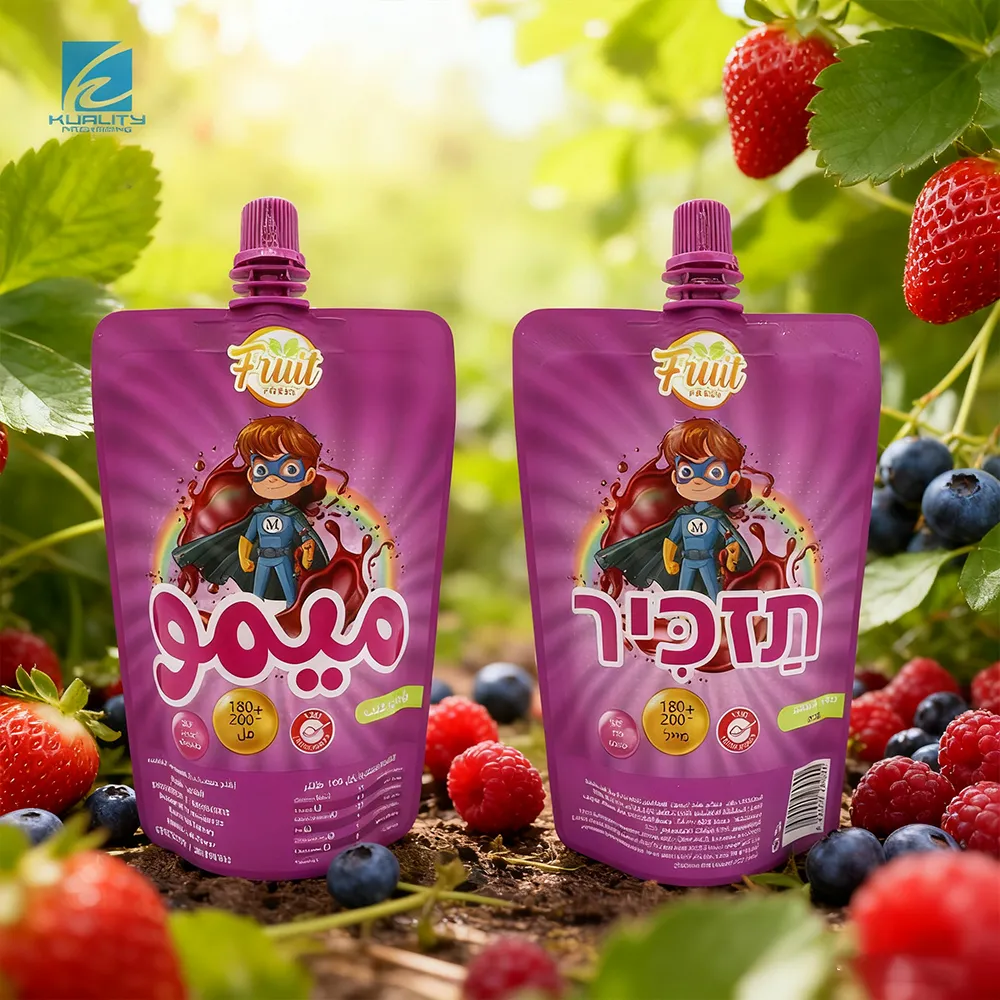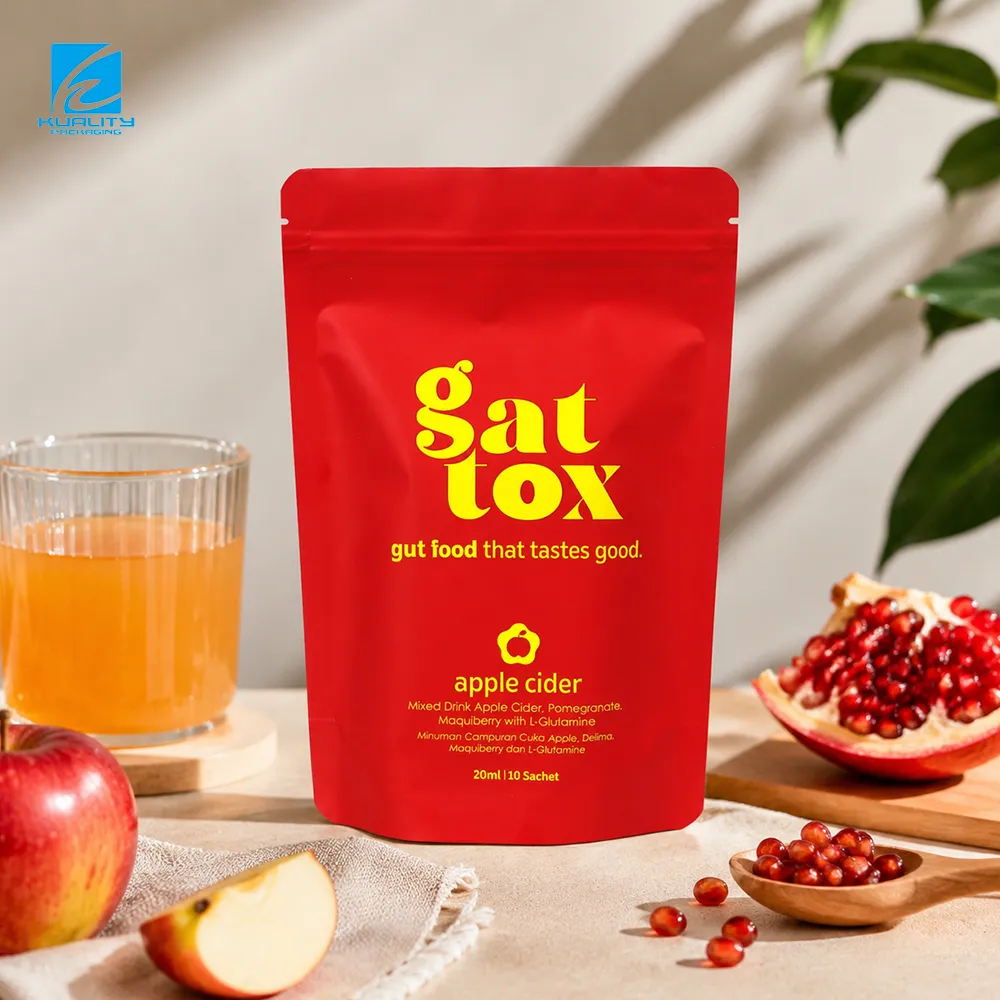
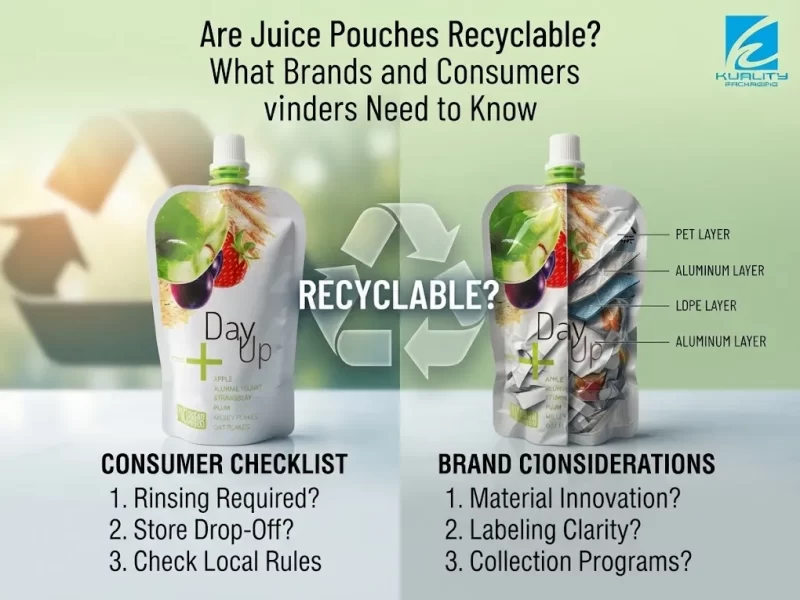
Some juice pouches are recyclable, but acceptance depends on their complete material structure and local collection system. Conventional mixed-material pouches generally aren’t suitable for standard household recycling. Mono-material designs can improve recyclability, but consumers must confirm an approved collection route, and brands must verify the finished package before making recycling claims.

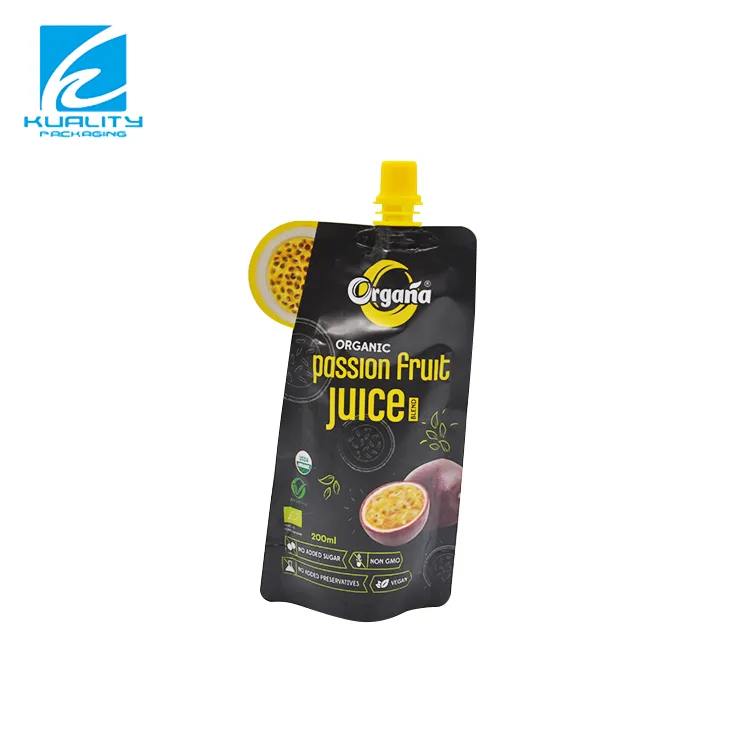

For beverage brands and wholesalers buying custom juice pouches, recyclability is a packaging specification that affects material selection, closures, artwork, and disposal instructions. Choosing a pouch requires checking both how it protects the juice and how customers can dispose of it after use.
Author: Even
Company: Huiyang Emballage
Why Are Conventional Juice Pouches Difficult to Recycle?
Conventional juice pouches are difficult to recycle because their bonded layers can combine different plastics, aluminum foil, and other components that standard recycling systems are not designed to separate. Their flexible shape also requires a collection and processing route suitable for films and pouches.
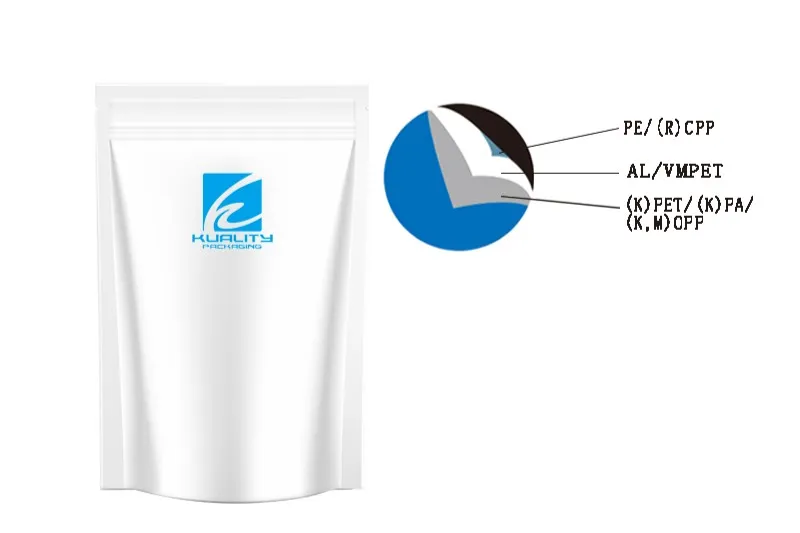
Each layer serves a purpose. The outer layer supports printing and handling, the barrier layer limits exposure to oxygen or light, and the inner layer provides sealing and food contact. These functions protect juice, but combining materials complicates post-use recovery.
Huiyang’s beverage packaging material guide discusses PET, aluminum, nylon, and PE structures. Buyers should request the actual specification for their selected pouch rather than assume that all juice packaging uses the same construction.
The wider recycling gap is substantial. According to the OECD Global Plastics Outlook, the world generated 353 million tonnes of plastic waste in 2019, and only 9% was ultimately recycled. These figures cover all plastic waste; they are not a juice-pouch recycling rate.
Which Types of Juice Pouches Can Be Recycled?
Juice pouches can be recycled when their finished construction meets the requirements of an available collection and recycling system. A mono-material designation supports material selection, but it does not establish that every local recycling service accepts the pouch.
| Juice pouch construction | Recycling consideration | What buyers should verify |
|---|---|---|
| Mixed-plastic laminated pouch | Different bonded polymers complicate recycling | Whether a specialist route accepts the exact construction |
| Aluminum foil laminated pouch | Foil and plastic layers require suitable processing | Whether an approved program accepts foil-containing drink pouches |
| PE-based mono-material pouch | A candidate for compatible PE-film recycling | Whole-package eligibility, including closures, inks and barriers |
| PP-based mono-material pouch | Requires a route accepting the specific PP pouch format | Local acceptance and package assessment |
| Pouch with spout and cap | Closure materials affect the finished package | Compatibility and disposal instructions for each component |
Huiyang’s mono-material pouch guide describes OEM/ODM development covering material systems, barrier designs, fitments, and artwork. These capabilities are relevant when evaluating a recyclable juice pouch, but the selected juice application still requires validation.
Can Juice Pouches Go in Household Recycling Bins?
Juice pouches belong in household recycling bins only when the local service explicitly accepts that pouch type. Acceptance of plastic bottles does not establish acceptance of flexible drink packaging.
In the United States, How2Recycle’s Store Drop-off guidance directs eligible PE-based flexible packaging to participating collection locations. Consumers should look for the assigned label and confirm the location’s requirements. A PE material description alone is insufficient.
In the United Kingdom, Recycle Now identifies collection points for plastic bags and wrapping, with selected stores accepting additional pouch formats. Its guidance requires checking the individual location’s accepted materials; it does not establish blanket acceptance for every juice pouch.
For brands selling across multiple countries, disposal instructions need market-specific verification. The same pouch can have different collection options in different destinations.
How Should Consumers Recycle Juice Pouches?
Consumers should identify an accepted collection route first, then prepare the pouch according to that route’s instructions. Putting an unaccepted pouch in a recycling bin does not create a recycling pathway.
- Read the package label. Check instructions for the pouch, cap, and any separate components.
- Confirm local acceptance. Check the municipal service, participating store, or named take-back program.
- Empty the pouch. Remove remaining juice and follow the program’s cleaning requirements.
- Dry it when required. How2Recycle Store Drop-off requires eligible food-contact packaging to be clean and dry.
- Handle the cap as instructed. Do not assume it should always be removed or always remain attached.
- Use the confirmed collection point. If no route accepts the pouch, follow local waste-disposal guidance.
How2Recycle specifically requires clean, dry preparation for eligible food-contact film packaging. Recycle Now also states that accepted films should be clean and free of food.

Are Recyclable Juice Pouches Suitable for Hot-Fill and Shelf-Stable Drinks?
Suitability for hot-fill or shelf-stable juice must be established through product-specific testing. A recyclable material designation does not prove heat resistance, oxygen protection, seal integrity, or the required shelf life.
For en juice pouch manufacturer, the specification needs to account for filling conditions, juice composition, storage temperature, and distribution. A chilled drink and an ambient-storage juice can require different packaging performance.
Before changing materials, brands should define:
- Filling temperature and treatment process.
- Required unopened shelf life.
- Oxygen and light protection.
- Spout-welding and sealing conditions.
- Transport and storage requirements.
Huiyang’s published spout pouch project account reports a mono-material project whose first batch leaked during filling. The company states that a slightly thicker film resolved the issue. This is a manufacturer-reported production example, rather than independent evidence of recycling performance.
The procurement lesson is practical: approve the material, filling process, and closure as one system before committing to bulk production.
What Should Brands Ask a Wholesale Juice Pouch Supplier?
Brands should request a documented specification for the finished pouch, evidence supporting its intended recycling route, and trial samples for their filling process. These requirements help distinguish a substantiated proposal from a general “eco-friendly” description.
| Procurement question | Evidence to request | Why it matters |
|---|---|---|
| What is the complete material structure? | Layer specification, thickness, and barrier details | Establishes what the pouch actually contains |
| What materials are used for the spout and cap? | Closure specifications | Prevents an incomplete material assessment |
| Which recycling route accepts it? | Package-specific assessment and destination-market guidance | Connects design with actual collection |
| Does it suit our juice and filling process? | Relevant test results and filling trials | Checks leakage, heat performance and product protection |
| What food-contact documentation applies? | Documentation for the intended market and use conditions | Supports suitability for the application |
| What are the order conditions? | MOQ, artwork costs, lead time and repeat-order terms | Helps smaller buyers plan cash flow and stock |
For small and medium wholesalers, ask whether the minimum order applies per size, per design, or per material structure. Multiple printed designs can increase inventory commitments even when the total order appears manageable.
When buying wholesale juice packaging bags, compare the total cost of approved packaging: pouches, artwork, tooling, trials, transport and potential rejects.
Why Should Buyers Assess the Whole Pouch Instead of Just the Film?
Buyers should assess the whole pouch because a suitable film does not establish the recyclability of a package containing closures, adhesives, printing, labels, and barrier layers. The finished product is what consumers discard, and collection systems receive.
How2Recycle’s published guidelines state that supplier pre-qualification does not guarantee a particular label for the final application. Attachments and product use can affect the assessment, and brands must submit the finished package application.
A useful purchasing method is to apply three approval checks:
- Package design: Does the complete pouch meet the intended recycling system’s requirements?
- Market access: Can customers in the destination market use an accepting collection route?
- Product performance: Does the pouch pass filling, storage, and distribution testing?
This creates a clearer decision than asking only, “Is the film recyclable?”
For example, a brand sourcing custom printed juice pouches with spouts should assess the printed pouch and closure combination, confirm disposal instructions for its sales market, and run filling trials before approving the artwork and bulk order.
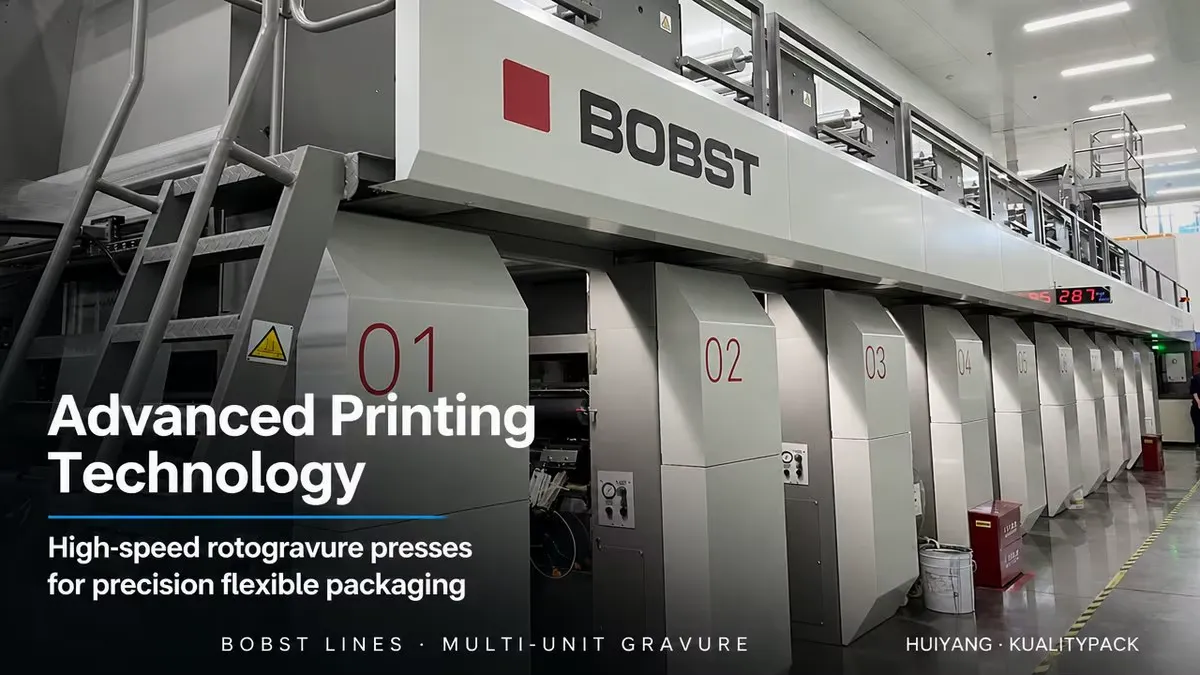
How Can Huiyang Packaging Support Custom Juice Pouch Projects?
Huiyang Packaging supports custom juice pouch sourcing through beverage packaging products, OEM/ODM customization, and flexible packaging development. Its website reports more than 25 years of experience supplying custom pouches and film solutions.
The company’s custom juice pouch range includes stand-up formats with straw holes and supports bulk orders and private-label branding. Its beverage packaging collection also includes spouted drink pouches.
Huiyang also describes ERP-based production management and an experienced R&D team on its website. These capabilities provide a basis for discussing specification development and production coordination with an OEM beverage packaging supplier.
If you are developing juice pouches for a new brand, regional distribution or wholesale supply, share your drink formulation, filling process, capacity, sales market, and order quantity with Huiyang Emballage. Request a proposed material structure, sample options, and a quotation, and ask what evidence supports any proposed recyclability claim.
What Else Should Brands and Consumers Know About Juice Pouch Recycling? — FAQ
Juice pouch recycling depends on the complete package and the available collection system. The following answers address common questions about materials, closures, and procurement.
Are aluminum foil juice pouches recyclable?
Aluminum foil juice pouches require a recycling route that accepts their bonded plastic-and-foil construction. Do not place them in a household recycling bin unless the local service explicitly accepts them.
Are juice pouches with spouts recyclable?
Some are recyclable through an appropriate route. The pouch body, spout, and cap must be assessed together, and consumers must follow the assigned disposal instructions.
Does mono-material mean a juice pouch is recyclable everywhere?
No. Mono-material describes the packaging construction. Collection access and processing requirements still determine where the finished pouch can be recycled.
Does “recyclable” mean the pouch contains recycled plastic?
No. Recyclability concerns disposal and recovery after use. Recycled content describes the material used to manufacture the package. Buyers should request separate evidence for each claim.
Can recyclable juice pouches be used for hot filling?
Only a structure validated for the specified filling conditions should be used. Confirm temperature tolerance, seal performance, closure compatibility, and product protection through testing.
Can small brands order custom juice packaging?
Huiyang’s juice pouch products support OEM/ODM and private-label customization. Small brands should request the MOQ and quotation for their particular size, material, and artwork; no single minimum order should be assumed across all products.
Konklusion
Some juice pouches are recyclable, but the complete packaging structure and local collection system determine whether they can actually be recycled. Mono-material designs improve recycling compatibility, while mixed-material pouches require suitable specialist collection routes. Consumers should follow the package label and confirm local acceptance before disposal.
For beverage brands and wholesalers, choosing recyclable juice pouches requires checking material specifications, spout and cap compatibility, filling performance, and destination-market recycling options. These checks help protect product quality and support accurate recycling claims.
Looking for custom juice pouches for your beverage business? Huiyang Emballage giver OEM/ODM-tilpasning and wholesale beverage packaging options. Share your filling process, pouch capacity, target market, and order quantity to request samples and a tailored quotation.
Relaterede produkter
-

Engros tudeposer til juice og drikkevarer - stående væskeposer med brugerdefineret tryk
-
Kina brugerdefineret gelépose leverandør, bulkformet stand up taske emballage engros
-
Custom Apple Juice Pouch OEM Printed Aluminum Foil Stand-Up Zipper Bag Wholesale
-

Brugerdefinerede juiceposer, tudposer Stå op fleksible poser Forseglet barriere med hængende hul Producent